



Robotic arms are now indispensable across a wide range of industries—from automotive manufacturing to metal processing and even healthcare. Yet the majority of these arms consist of large, fixed installations. Deploying them has typically required major facility overhauls, extensive layout redesign and the adoption of comprehensive safety measures. Now, a groundbreaking new robotic arm is challenging these long-held assumptions and dramatically expanding the possibilities for where and how robotic manipulation can be applied. What innovative technology powers this breakthrough? A conversation with the arm’s developers offers a glimpse of the shop floor of the future.
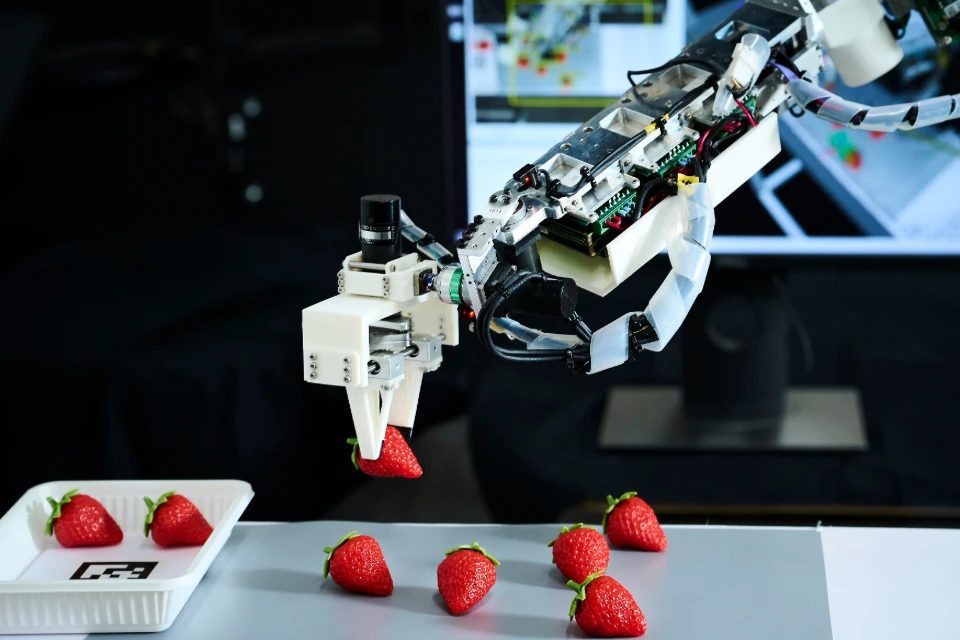
Automation in factories and warehouses has made significant advances, yet certain areas on the shop floor still require human hands. These include such tasks as inter-process transport and the handling of irregularities—essentially, the various supporting operations that fill the gaps between core processes, and which fixed equipment cannot fully address. Kailas Robotics Inc. has developed a mobile robotic arm, “MobiRobo,” precisely to bridge these gaps.
What the company has created is a compact, lightweight mobile manipulator capable of seamlessly handling both motion and manipulation. Conventional robotic arms typically struggle to maintain precision unless mounted on a fixed base, but MobiRobo achieves high task accuracy even while on a moving platform. “We are overturning the longstanding assumption that robotic arms must be fixed in place, and have adapted our technology to fit real-world on-site operations,” says SHIOMI Yoshihisa, CEO of the company.
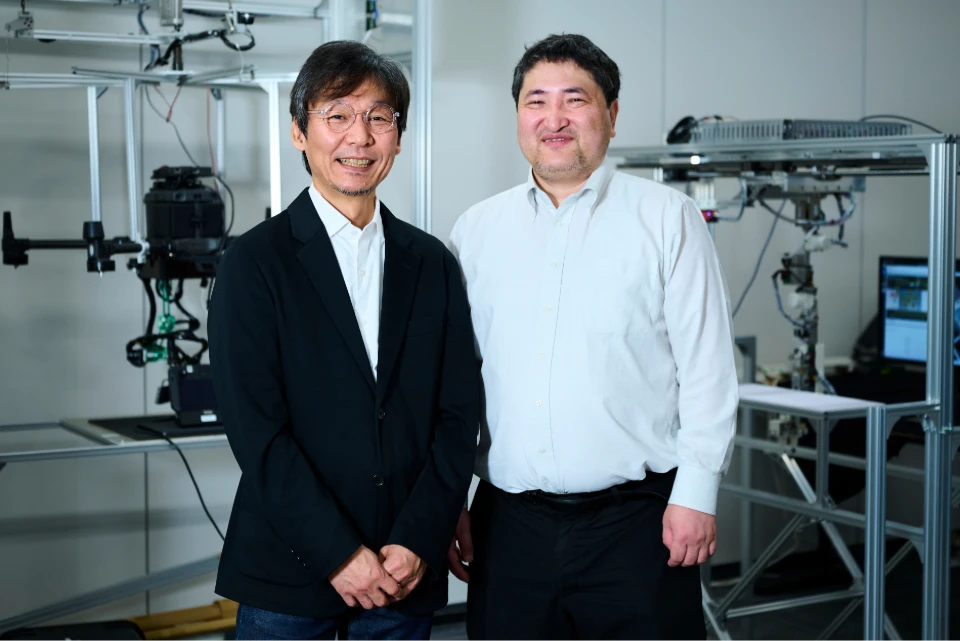
The core of this innovation is a patented arm technology that enables stable grasping of target objects even when the arm’s base is shaking. It detects disturbances—such as vibrations, uneven floor surfaces, or changes in load—that would otherwise compromise task precision, then automatically adjusts the arm’s position to maintain a steady grip. This breakthrough technology ensures critical real-world performance: the arm does not lose its aim the instant movement stops, and grasping or holding does not cause disruptive reaction forces that throw off subsequent operations. As a result, MobiRobo achieves reliably high success rates in practical deployment. Thanks to its built-in stability, the arm can grasp objects while in motion even when mounted on inherently unstable platforms, such as autonomous mobile robots or drones.
Adiyasuren Altanbileg, CTO of the company, points out the critical gap that often lies between laboratory demonstrations and real-world deployment: “Of course, making the technology work is essential—but what truly matters is enabling it to function reliably in actual on-site conditions.” Prioritizing weight reduction makes the arm more prone to deformation and vibration when external forces are applied. Conversely, designing for greater resistance to shaking tends to require piling on more sensors, control devices, and actuation power—resulting in a heavier, bulkier, and far more expensive system ill-suited for practical use. To simultaneously achieve three seemingly conflicting goals—compact and lightweight design, high-speed operation, and rock-solid end-effector stability—the company took a holistic approach, optimizing everything from actuator design to the overall control architecture. The developers express strong confidence in their system’s ability to handle the diverse and unpredictable challenges encountered in real-world environments.
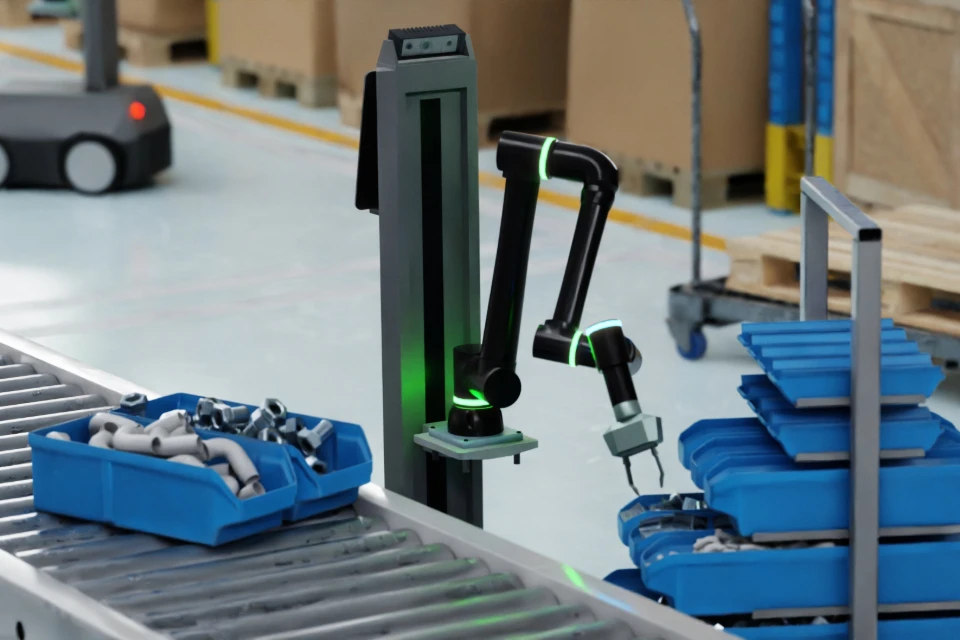
Currently, MobiRobo is undergoing demonstration testing of the sorting process for inbound and outbound operations at logistics warehouses. The goal is for the robot arm to serve as the “final piece” on the shop floor—identifying, grasping, and securely holding small parcels or irregularly shaped items that conventional automated sorters cannot handle, then transporting them while maintaining that grip. This means it would be entrusted with the kind of delicate, detail-oriented tasks that have traditionally depended entirely on human workers.
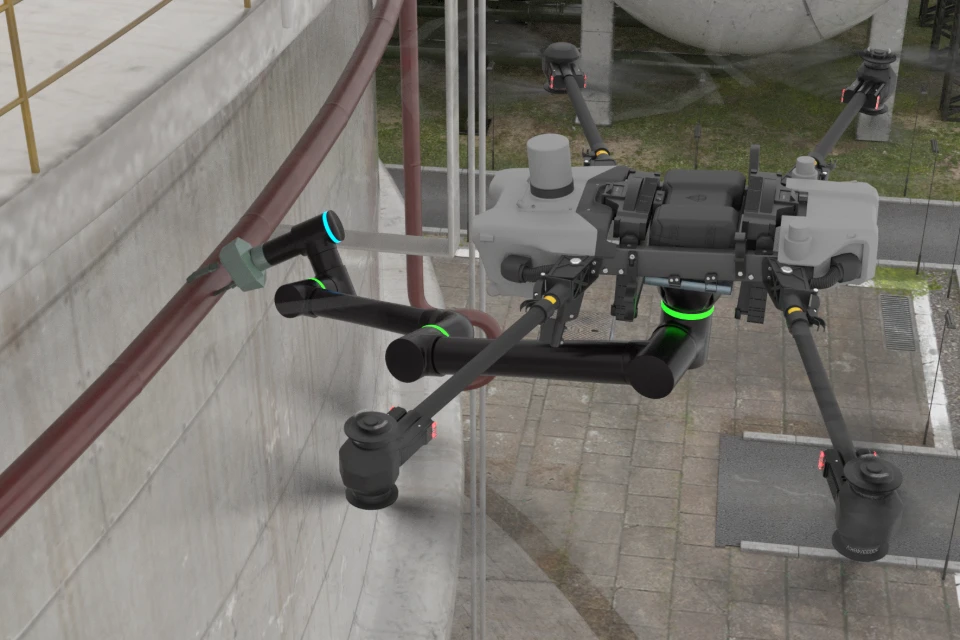
Another promising arena where MobiRobo is generating significant interest is infrastructure maintenance. The repair of aging infrastructure is an urgent concern for Japan and many other countries. While drone use has expanded in the inspection of bridges, power transmission facilities, and similar structures, applications have largely remained limited to capturing images while in flight. However, by adding MobiRobo as a “working hand” that can physically touch objects and, when needed, perform simple tasks, the scope of drone work expands dramatically—beyond mere inspection and repair to non-destructive testing that can assess defects or degradation without damaging the equipment itself. In environments fraught with danger, high costs, labor shortages, and stringent accuracy requirements, the push for robot adoption is accelerating. Shiomi notes, “We are already advancing projects with Japanese power grid and railway operators,” indicating that steady progress is being made toward practical implementation.
Kailas Robotics has established a presence in North America to promote the adoption of MobiRobo there as well. Interest in robotics runs high in the region, and the company senses a strong demand for replacing manual on-site work with robots as early as possible. “Expectations for automation and labor reduction through robotics are exceptionally high—not only in North America, but worldwide—and we aim to respond to those diverse needs," says Shiomi.
Kailas Robotics envisions a world where MobiRobo is fully implemented: one in which robots reliably take over the repetitive and hazardous tasks that still remain on the shop floor. This frees up human time and energy to focus on the domains that only people can truly excel in—those that demand imagination, judgment, and creative decision-making. By placing “the right robot in the right place” and enabling it to deliver its full potential, the company hopes to help foster a society enriched by harmonious coexistence between humans and robots. To realize this vision, Kailas Robotics appears committed to the continuing refinement of its dramatic new technology.


