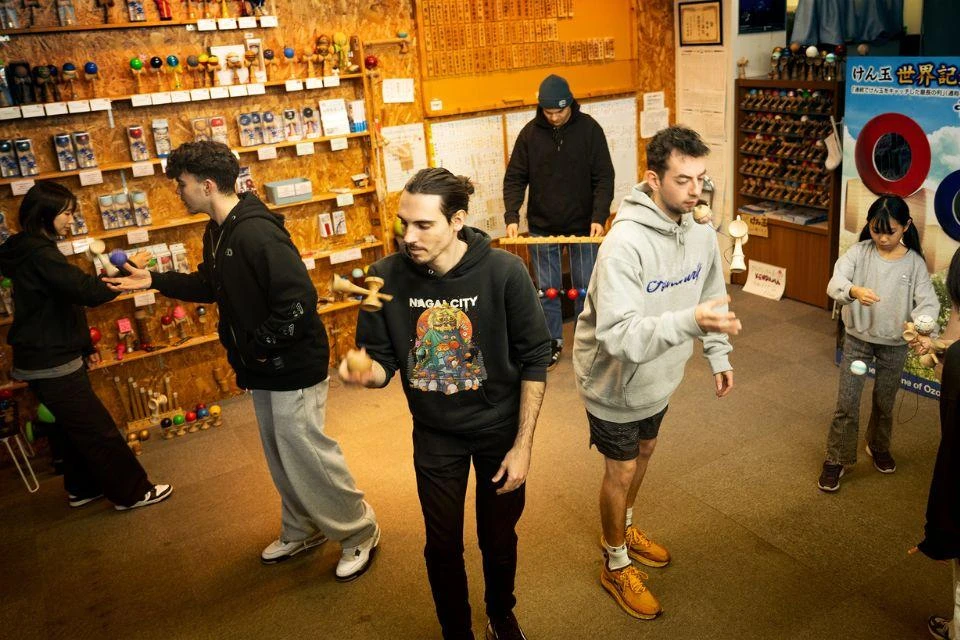
Did you know that kendama, a traditional cup-and-ball game that has been popular in Japan since the eighteenth century, is finding a global audience as a trendy new skill sport? The city of Nagai, Yamagata Prefecture, which manufactures most of Japan’s competition-certified kendama, is now harnessing the appeal of the game to revitalize its economy. Driving the effort is a local project that has won the support of top international players.
In recent years, the traditional Japanese game of kendama has evolved into a serious skill sport in which players compete to perform dazzling tricks. Videos of stylish moves and competition play shared on social media are wowing enthusiasts from Romania to the United States, and the annual Kendama World Cup attracts top players from around the globe eager to showcase their own original moves.
In Japan, most competition-certified kendama are manufactured in Nagai, Yamagata Prefecture, where abundant forest resources nourish a thriving woodworking industry. Tops and other wooden toys have been manufactured in Nagai since the 1960s, and after the Japan Kendama Association (JKA) was founded in 1975, the city became a key supplier of professional-grade kendama approved by the JKA. Nagai still manufactures around 70% of Japan’s professional kendama today. This history has made kendama part of Nagai’s civic culture, enjoyed by people of all ages and walks of life. Children learn about kendama in school, and adults attend kendama workshops to polish their skills.

In 2014, the city put kendama at the center of its civic revitalization efforts by launching the Nagai Kendama Furusato Project. The heart of the project is a community space called SPIKe, located in a renovated shopfront just outside Nagai Station. SPIKe is staffed by expert kendama players who can offer local residents and visitors alike a taste of kendama at the highest level. The facility also hosts kendama classes, dan and kyu ranking certification events, and even kendama painting workshops. In 2024, SPIKe welcomed 3,665 visitors.
“We’ve had top kendama players staffing SPIKe since day one,” says KIMURA Mayumi, director of the Nagai City Tourism and Cultural Exchange Division. “The opportunity to drop by and get advice on technique, or just watch them perform amazing tricks without breaking a sweat, is a major draw for everyone from tourists to children on their way home from school.”
In 2021, SPIKe welcomed its first non-Japanese manager: Shelby Brown of Arkansas, USA. Brown discovered kendama while working as an Assistant Language Teacher in Fukui Prefecture and mastered the art through solo practice. When attending the 2021 Kendama World Cup in Hatsukaichi, Hiroshima Prefecture, Brown learned that SPIKe was recruiting staff and sent in his application, which was promptly accepted.
Shelby was initially stationed in Nagai as a Local Vitalization Cooperator. This is a national program in which towns in outlying parts of Japan invite people from urban areas to work on local revitalization efforts with the eventual goal of settling in the community. After his three-year term was complete, Shelby remained in Nagai, where he currently serves as a project manager with the role of bringing together city employees, local businesses, and kendama players from overseas.

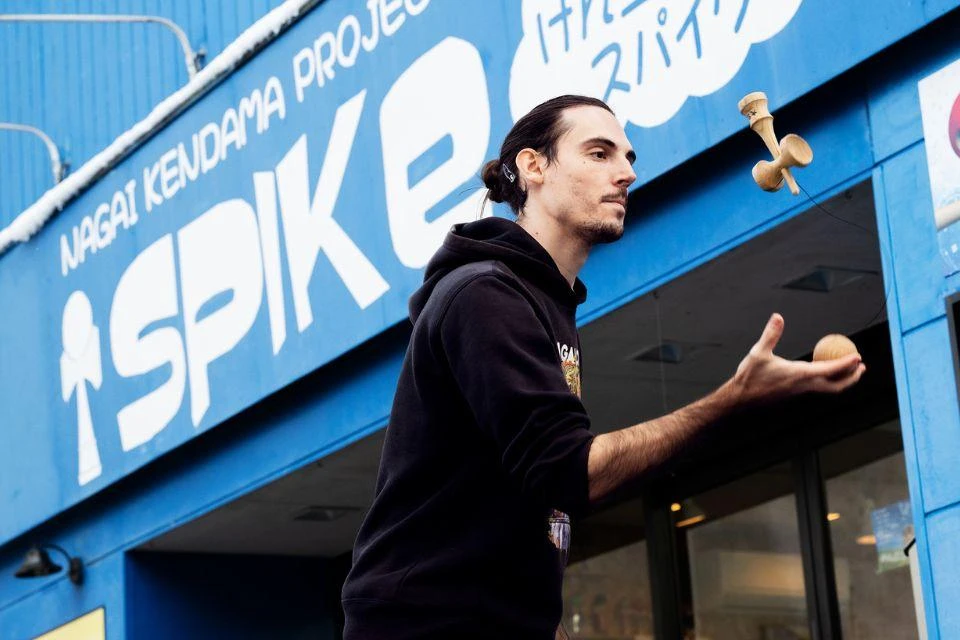
Once word got out about the opportunities in Nagai to engage with kendama professionally, overseas players became frequent visitors to the city. One of these, Lyndon Whalen of Georgia, USA, has now moved to Nagai. When Whalen was competing at the 2024 Kendama World Cup on the US professional kendama team, he met someone from SPIKe, and as a result of that conversation, he came to Japan in 2025. “It’s hard to make a living from kendama alone in the States,” says Whalen. “Here, I can teach children and promote kendama more broadly while also honing my own skills, which is a real plus. The great thing about Nagai is that people of every age here are so familiar with kendama techniques that you can earn a lot of respect by pulling off a cool trick.”
The project staff are now working toward a new objective: overhauling Nagai’s regular kendama tournament into a worldwide event. “We’ve always held the tournament in February,” says Shelby. “But the snow here at that time of year makes it hard to get around, so we’re thinking of rescheduling to early summer or autumn and making it part of a package tour that also includes local sightseeing. Nagai has mountains that are just right for hiking, and traditional festivals in summer. It could be a magical experience for overseas visitors.”
“The city is now thinking of ways to create an environment that supports our Local Vitalization Cooperators even after their term ends,” says Kimura. “Their performances at local events and lessons at after-school care facilities and seniors’ clubs are currently done for free, but we’re looking into setting an appropriate fee schedule. We’d like to make our kendama-related activities part of the engine driving our local economy.”
Nagai as sacred ground for kendama enthusiasts worldwide—a dream that may yet come true.