



In the face of fast-moving fashion trends, the apparel manufacturing industry has embraced a cycle of mass production, mass consumption, and mass disposal, adding to an environmental burden that is now a matter of global concern. Not long ago, an apparel manufacturer was founded in Japan with the aim of using sustainable materials to address this crisis from the production side. Recognizing the possibilities inherent in a certain plant that grows wild in Southeast Asia, the company has embraced the challenge of reducing the environmental burden of production by rethinking how clothes are manufactured—starting with the materials used.
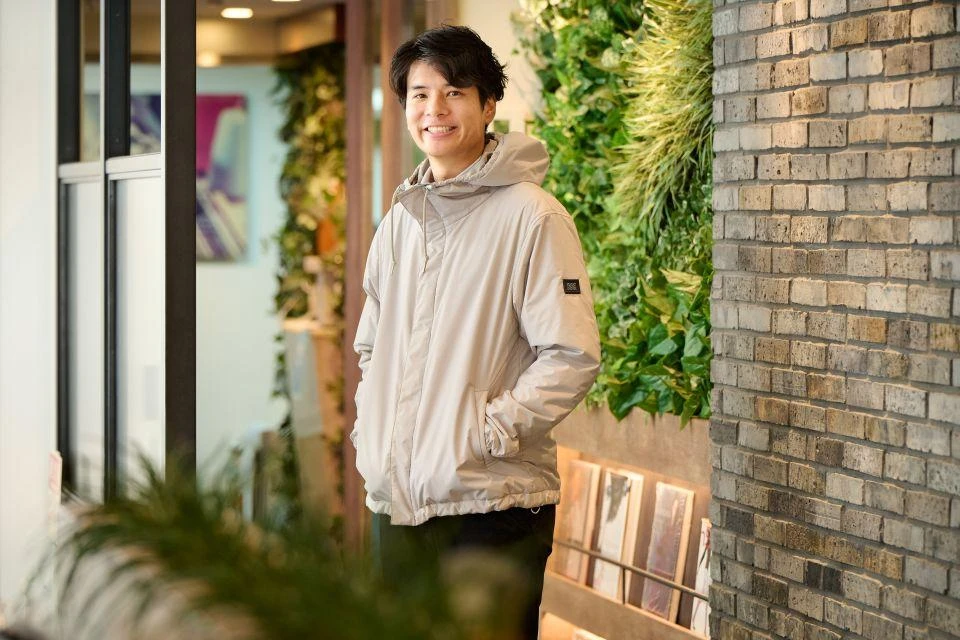
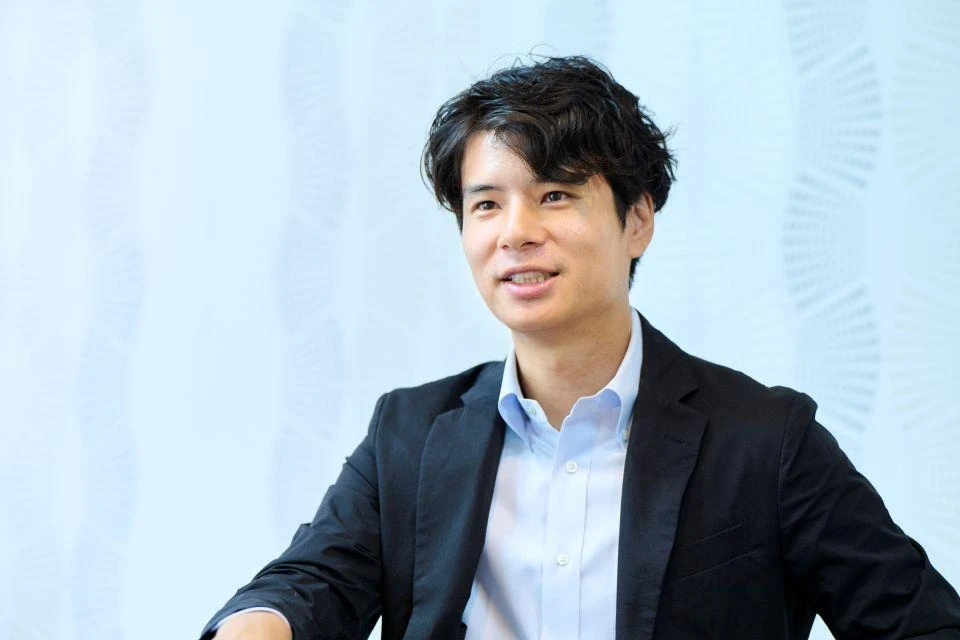
FUKAI Kisho, CEO of KAPOK JAPAN Co., Ltd., in an Air Light jacket from the company’s original KAPOK KNOT brand. Using fibers from the kapok plant provides all the warmth of a traditional down jacket at a weight of just 500 grams.
Environmental issues arise in apparel manufacturing at every stage of the product life cycle, from production and sales to consumption and disposal, and have become a globally shared problem. According to the United Nations Conference on Trade and Development, the fashion industry is the “second most polluting industry in the world,” responsible for more carbon emissions “than all international flights and maritime shipping combined.” One Japanese company is working on a novel solution to some of these issues by making use of kapok, a Southeast Asian plant that has generally been overlooked by the apparel industry. That company, founded in 2020, is KAPOK JAPAN Co., Ltd.
KAPOK JAPAN’s apparel brand KAPOK KNOT features clothes made using fibers derived from kapok. Kapok, a tree that grows wild across much of Indonesia and other Southeast Asian countries, has many characteristics that make it worthy of note as a potential raw material for apparel. Unlike cotton, which requires large quantities of agrochemicals and water, kapok is highly self-sufficient, needing almost no agrochemicals or fertilizer. A single tree can produce 300 to 400 seedpods, and the fiber can be harvested from those seedpods without felling the tree, so kapok plantations can be maintained over the long term. All this makes kapok a highly sustainable raw material. Its fibers are 80% hollow, so they weigh just one-eighth as much as cotton. In cold weather, they absorb humidity and emit heat, and in hot weather they release humidity with a cooling effect. However, the fibers are so light and short that they are difficult to process into yarn. This shortcoming was compounded by durability issues, so they were seldom used to make clothing in the past. Even in the days before synthetic fibers made from fossil fuels, kapok fiber was mostly used for stuffing in pillows and life vests.
When KAPOK JAPAN’s founder and CEO FUKAI Kisho was building up experience at major fiber makers as well as the ladies’ apparel manufacturer that his family owned, he began to question the fashion industry’s dependence on mass production and mass consumption. “I reasoned that changing the structure of the entire industry wouldn’t be easy, but switching to a more sustainable material to reduce the environmental burden of production at least a little would be possible right away,” says Fukai. “And, as I researched the materials available, I discovered kapok.”
Recognizing kapok’s functionality and sustainability was only the first step. Finding a way to use it to make garments was another challenge entirely. Fukai arranged tours of kapok plantations and processing centers in Indonesia, making contact through the country’s consulate in Japan. After his fact-finding mission, he decided to use kapok as stuffing rather than as a textile for apparel. A lengthy research project with a major Japanese fiber manufacturer was ultimately successful in applying a special processing technique to turn out sheets of kapok. This opened the door to manufacturing garments that were lightweight, offered high heat retention, and were less of a burden on the environment.
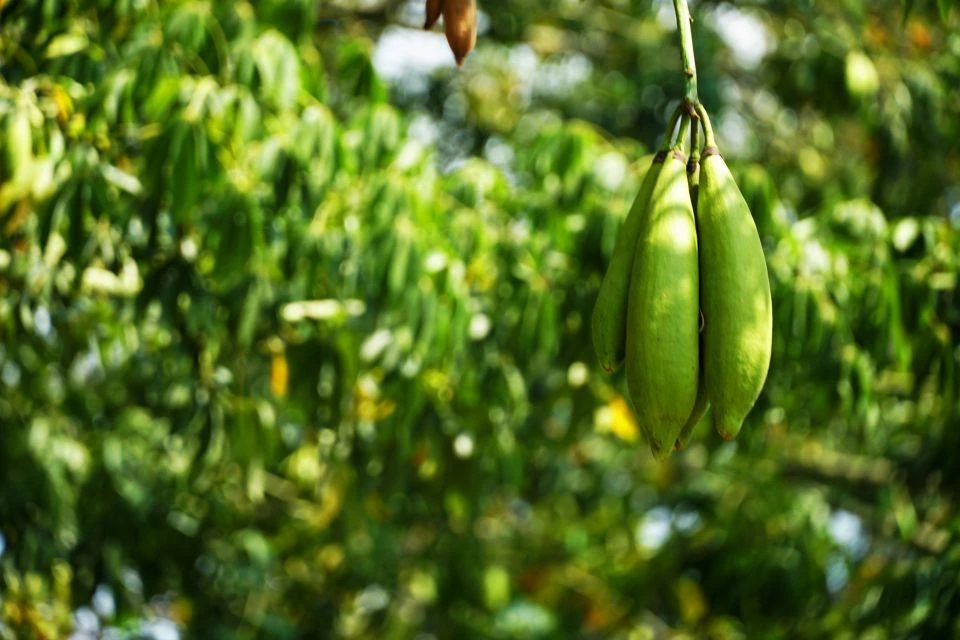
Kapok grows wild in Indonesia, with large seedpods hanging from its branches. These are harvested when ripe to extract the fibers within—but the tree itself is left standing.
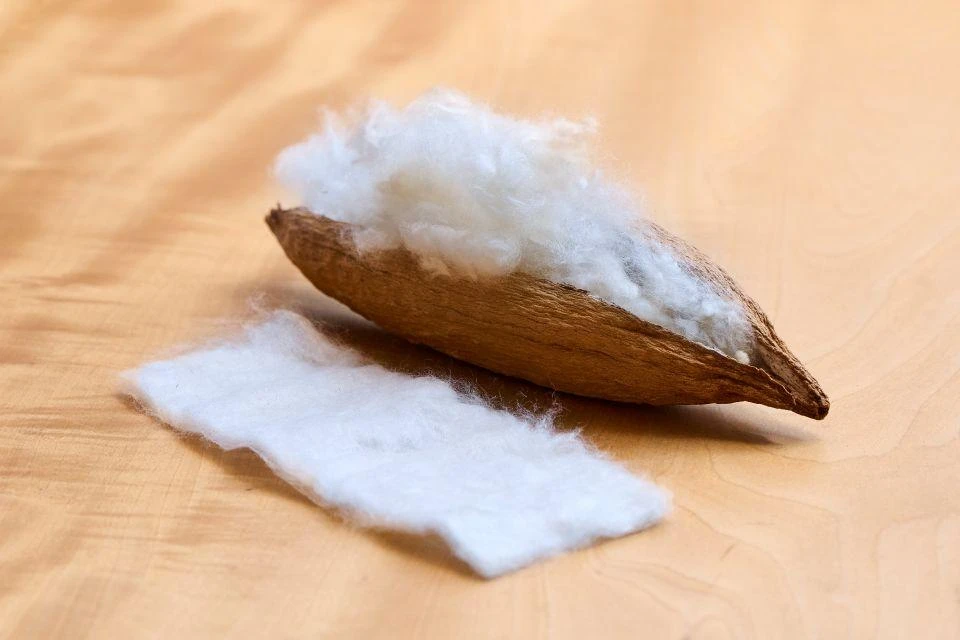
Kapok fibers are turned into sheets using KAPOK JAPAN’s special processing technique.
In 2019, ahead of the founding of KAPOK JAPAN, Fukai crowdfunded the kapok down jacket that would be the inaugural KAPOK KNOT product. This attracted media interest, helping to raise the brand’s profile.
Down jackets are traditionally stuffed with down and feathers from waterfowl like ducks and geese, but animal welfare concerns have raised questions about this practice in recent years. A down jacket stuffed with kapok sheets represents a solution to this issue. In 2024, Fukai launched a new development project named “Beyond.” The project has run repeated trials processing kapok into various shapes in an attempt to reproduce the “fluff” of down. “In the future, I’d like to make kapok a practical, all-purpose alternative to down, freeing us from dependence on animal materials and pushing the market toward change by switching to plant fibers,” says Fukai.
Today, KAPOK KNOT offers everything from jackets to room wear. The kapok plantations, processing facilities, and sewing workshops that contribute to these products all have contracts directly with the company and are visited by Fukai personally. “In this industry, division of labor via subcontracting and sub-subcontracting is the norm,” says Fukai. “We’re taking a different approach, building our own individual supply chain with a focus not only on quality but also on the labor environment of the people who do the work.”
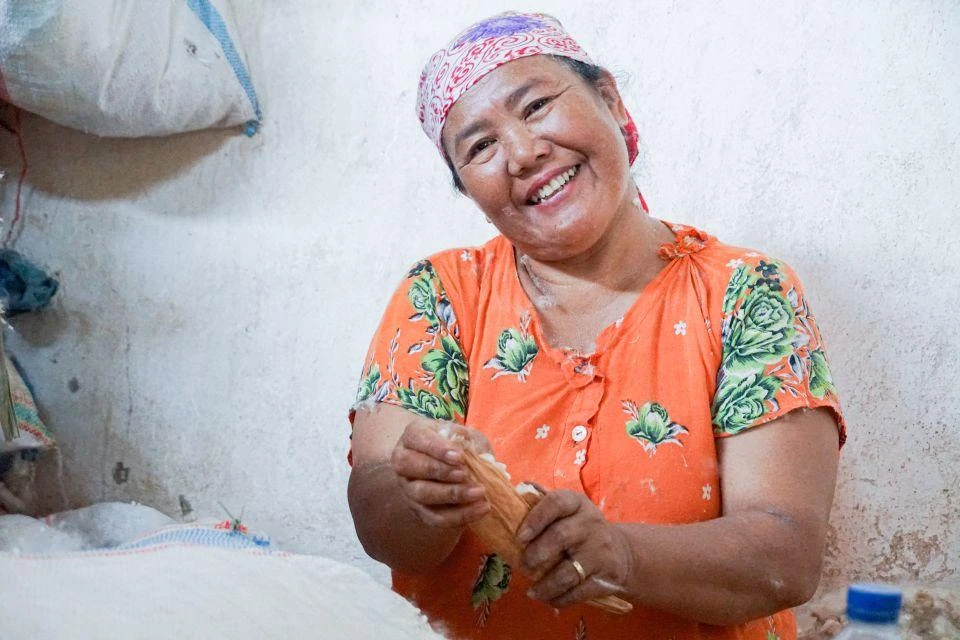
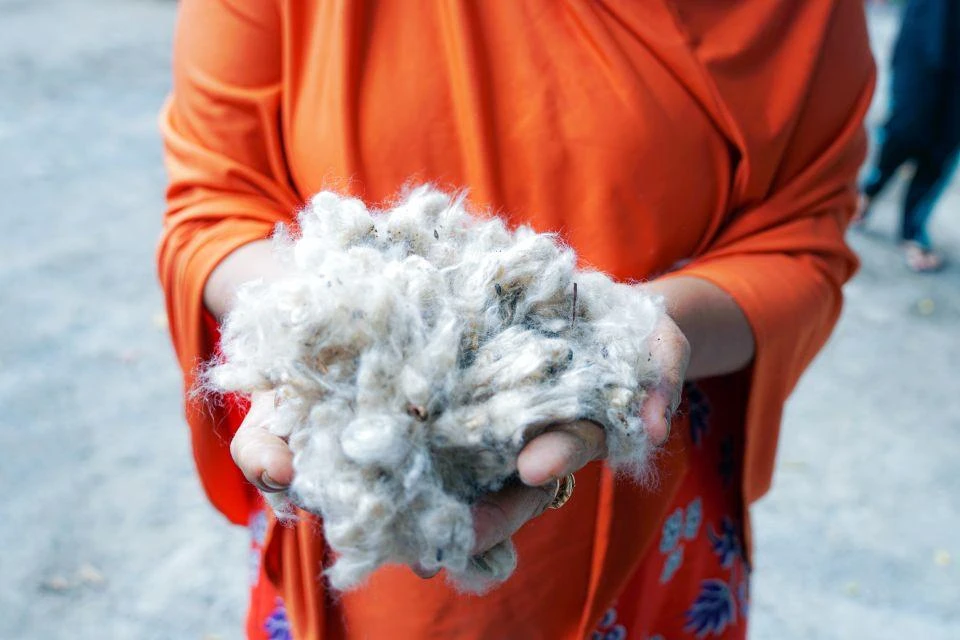
Kapok fiber is extracted from the harvested seedpods by hand on Indonesian plantations. If demand for kapok grows, this will generate local employment and encourage forest conservation.
Some brands in Europe and the United States have shown interest in kapok from a sustainability standpoint, says Fukai, but they are still searching for a way to use it. Japan is both geographically and psychologically nearer to Southeast Asia, where kapok is grown, making it a major presence there.
“I see an opportunity for Japan to become a global fiber hub through kapok,” says Fukai. “In the 1950s and 1960s, Japan was a world center for fibers. By combining Southeast Asia’s rich botanical resources with Japan’s fiber technology, I believe that we can reclaim that position.”
Fukai is also working on R&D that seeks to replace the fossil fuel–based oil catchers currently in use on the ocean with kapok-based alternatives. Experiments to create biodiesel fuel from kapok seeds are also underway.


